Documentation Index
Fetch the complete documentation index at: https://docs.sezzle.com/llms.txt
Use this file to discover all available pages before exploring further.
This guide walks you through integrating the Sezzle iOS SDK into your app. By the end, your app will display Sezzle promotional messaging on product pages and launch Sezzle checkout.
Prerequisites
- iOS 15.0+ deployment target
- Swift 5.9+
- A Sezzle merchant account with your Public API Key
- A backend server to capture payments after checkout
1. Installation
Swift Package Manager
CocoaPods
- In Xcode, go to File > Add Package Dependencies
- Enter the repository URL:
https://github.com/sezzle/sezzle-merchant-sdk-ios.git
- Select Up to Next Major Version from the latest release
- Add
SezzleMerchantSDK to your target
Add to your Podfile:Then run:
Requirements: iOS 15.0+, Swift 5.9+
2. Configuration
Initialize the SDK once at app startup in your AppDelegate:
import SezzleMerchantSDK
@main
class AppDelegate: UIResponder, UIApplicationDelegate {
func application(
_ application: UIApplication,
didFinishLaunchingWithOptions launchOptions: [UIApplication.LaunchOptionsKey: Any]?
) -> Bool {
SezzleSDK.shared.configure(
publicKey: "sz_pub_your_key_here",
environment: .production // use .sandbox for testing
)
return true
}
}
| Parameter | Type | Default | Description |
|---|
publicKey | String | Required | Your Sezzle public API key |
environment | SezzleEnvironment | .production | .sandbox for testing, .production for live |
Never include your private API key in the app. The SDK only uses the public key. Use your private key server-side to capture payments.
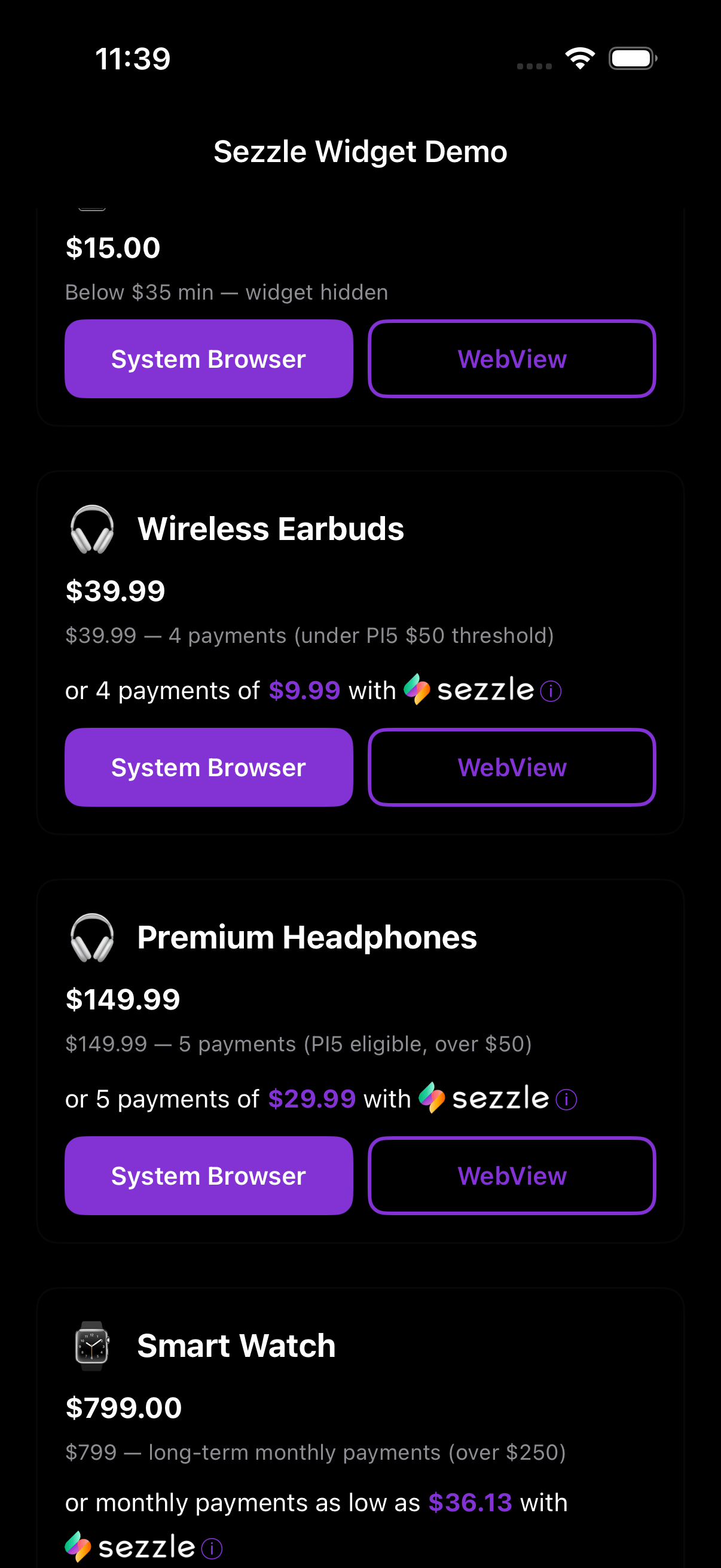
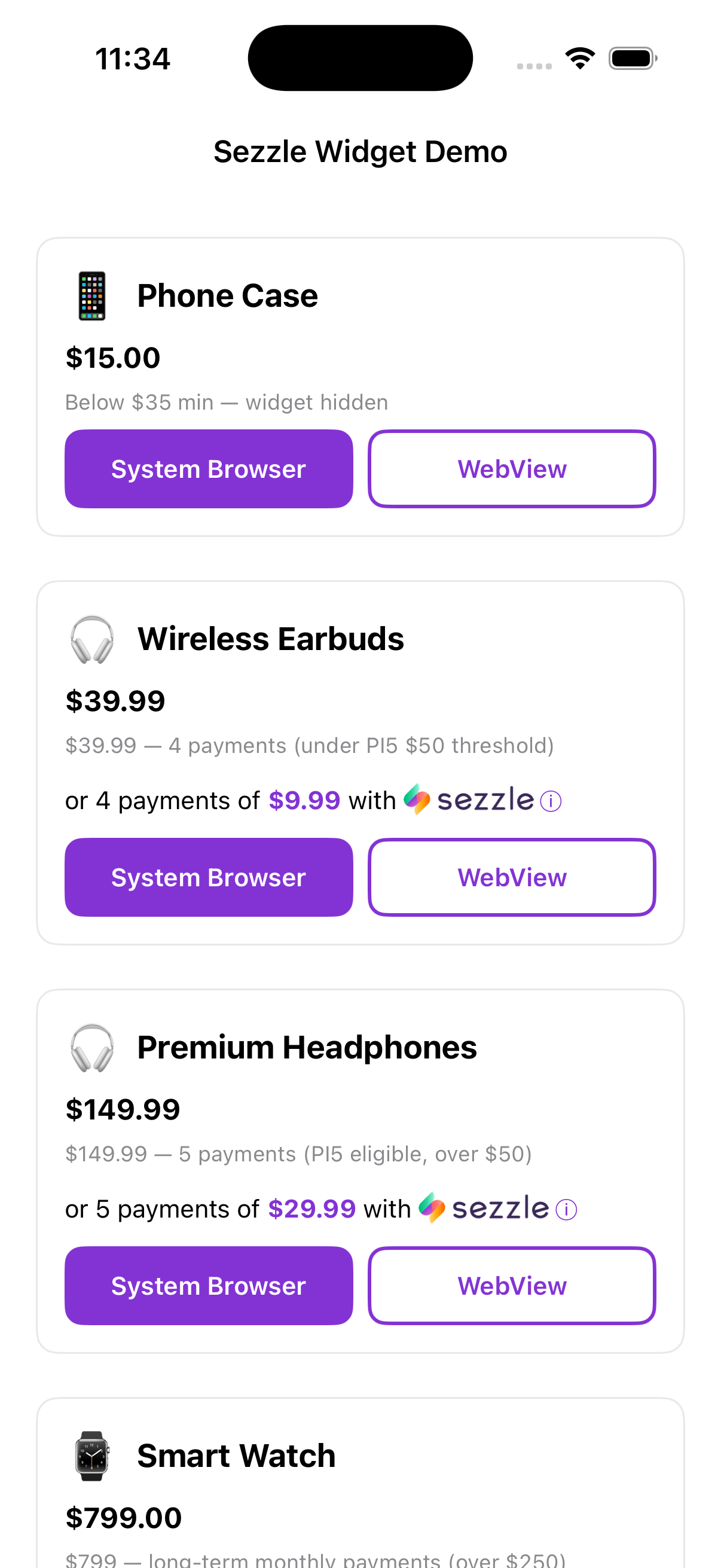
Add a SezzlePromotionalView to your product page to display installment pricing:
import SezzleMerchantSDK
let promoView = SezzlePromotionalView(
amountInCents: 9999, // $99.99
presentingFrom: self // UIViewController for modal presentation
)
view.addSubview(promoView)
The widget automatically shows the correct message based on the price and updates when you call:
promoView.update(amountInCents: 14999) // price changed to $149.99
All Parameters
SezzlePromotionalView(
amountInCents: Int,
currency: String = "USD",
style: SezzlePromotionalStyle = .light,
widgetConfig: SezzleWidgetConfig = .default,
presentingFrom viewController: UIViewController
)
| Parameter | Type | Default | Description |
|---|
amountInCents | Int | Required | Product price in cents (e.g., 4999 = $49.99) |
currency | String | "USD" | ISO 4217 currency code (e.g., "USD", "CAD") |
style | SezzlePromotionalStyle | .light | .light for light backgrounds, .dark for dark |
widgetConfig | SezzleWidgetConfig | .default | Controls pricing thresholds and Pay-in-5 |
presentingFrom | UIViewController | Required | View controller to present the info modal from |
The widget auto-detects dark mode and switches styles via traitCollectionDidChange. If you want to force a specific style, pass .light or .dark explicitly.
All config parameters are optional — the widget works out of the box with sensible defaults:
| Parameter | Default | Description |
|---|
minPriceInCents | 3500 ($35) | Minimum price to show the widget |
maxPriceInCents | 250000 ($2,500) | Maximum price for short-term (PI4/PI5) |
enablePayIn5 | true | Show “5 payments” for prices at or above the PI5 threshold |
pi5MinPriceInCents | 5000 ($50) | Price threshold for Pay-in-5 |
longTermConfig | nil (disabled) | Enable long-term monthly payments — set to a SezzleLongTermConfig to activate |
To customize, pass only the values you want to override:
let config = SezzleWidgetConfig(
longTermConfig: SezzleLongTermConfig(
minPriceInCents: 25_000 // $250+ shows monthly payments
)
)
let promoView = SezzlePromotionalView(
amountInCents: 79900,
widgetConfig: config,
presentingFrom: self
)
Custom Promotional Text
If you need full control over the UI, use SezzlePromoDataHandler to get a styled NSAttributedString with the Sezzle logo inline:
SezzlePromoDataHandler.getMessage(amountInCents: 9999) { attributedString in
myLabel.attributedText = attributedString
}
4. Checkout
Build the Checkout Object
let checkout = SezzleCheckout(
customer: SezzleCustomer(
email: "customer@example.com",
firstName: "Jane",
lastName: "Doe",
phone: "+15551234567",
billingAddress: SezzleAddress(
street: "123 Main St",
city: "Minneapolis",
state: "MN",
postalCode: "55401",
countryCode: "US"
)
),
order: SezzleOrder(
referenceId: "order-12345",
description: "Wireless Earbuds",
amount: SezzleAmount(amountInCents: 4599, currency: "USD"),
items: [
SezzleItem(
name: "Wireless Earbuds",
sku: "WE-001",
quantity: 1,
price: SezzleAmount(amountInCents: 3999, currency: "USD")
)
],
taxAmount: SezzleAmount(amountInCents: 350, currency: "USD"),
shippingAmount: SezzleAmount(amountInCents: 250, currency: "USD")
)
)
Customer Fields
| Field | Required | Description |
|---|
email | Yes | Customer email address |
firstName | No | Customer first name |
lastName | No | Customer last name |
phone | No | Customer phone number |
dob | No | Date of birth ("YYYY-MM-DD") |
billingAddress | No | Billing address (SezzleAddress) |
shippingAddress | No | Shipping address (SezzleAddress) |
tokenize | No | Tokenize customer for future orders |
Order Fields
| Field | Required | Description |
|---|
referenceId | Yes | Your internal order/reference ID |
description | No | Order description |
amount | Yes | Total order amount in cents + currency |
intent | No | .auth (default, capture later from your backend) or .capture (auto-capture at checkout completion) |
items | No | Line item details |
discounts | No | Discount line items ([SezzleDiscount]) |
taxAmount | No | Tax amount breakdown |
shippingAmount | No | Shipping amount breakdown |
metadata | No | Custom key-value pairs. The SDK automatically includes _sdk_platform, _sdk_version, _device_model, and _os_version — avoid using keys prefixed with _. |
locale | No | Checkout locale (.enUS, .enCA, .frCA) |
checkoutFinancingOptions | No | Restrict to specific plans: .fourPayBiweekly, .fourPayMonthly, .sixPayMonthly. Optional — omit to let Sezzle show all eligible plans. |
Address Fields (SezzleAddress)
| Field | Description |
|---|
name | Full name |
street | Street address line 1 |
street2 | Street address line 2 |
city | City |
state | State or province |
postalCode | Postal/ZIP code |
countryCode | ISO country code (e.g., "US") |
phone | Phone number |
Start Checkout
SezzleSDK.shared.startCheckout(
checkout,
from: self, // presenting UIViewController
delegate: self, // SezzleCheckoutDelegate
mode: .systemBrowser // or .webView
)
Handle the Result
Conform to SezzleCheckoutDelegate:
extension ProductViewController: SezzleCheckoutDelegate {
func checkoutDidComplete(result: SezzleCheckoutResult) {
// For this flow, `result.orderUUID` is populated.
// (For the server-driven flow, see Section 8.)
if let orderUUID = result.orderUUID {
// Send orderUUID to your backend to capture payment
// POST /v2/order/{orderUUID}/capture
print("Order completed: \(orderUUID)")
}
}
func checkoutDidCancel() {
// Customer closed checkout without completing
print("Checkout cancelled")
}
func checkoutDidFail(error: SezzleError) {
// Handle the error
switch error {
case .networkError(let underlying):
print("Network error: \(underlying)")
case .apiError(let statusCode, let message):
print("API error \(statusCode): \(message)")
case .browserDismissed:
print("Browser dismissed")
case .notConfigured:
print("SDK not configured")
case .invalidResponse:
print("Invalid response")
}
}
}
After checkoutDidComplete, send result.orderUUID to your backend server. Your server should call POST /v2/order/{orderUUID}/capture using your private API key to capture the payment. See the Orders API for details.
5. WebView Mode
By default, checkout opens in ASWebAuthenticationSession (system browser). To keep the user inside your app, use WebView mode:
SezzleSDK.shared.startCheckout(
checkout,
from: self,
delegate: self,
mode: .webView
)
System Browser (Default)
WebView
| Mode | Pros | Cons |
|---|
.systemBrowser | Secure, shares Safari cookies, recommended | Brief context switch |
.webView | Stays in-app | No cookie sharing, user logs in every time |
6. Dark Mode
The SDK automatically adapts to the device’s appearance setting. The promotional widget, installment modal, and checkout modal all support dark mode.
If you need to force a specific style (e.g., your app doesn’t follow the system setting):
let promoView = SezzlePromotionalView(
amountInCents: 9999,
style: .dark, // force dark style
presentingFrom: self
)
7. Error Handling
All errors are delivered via SezzleCheckoutDelegate.checkoutDidFail(error:):
| Error | When | Suggested Action |
|---|
.notConfigured | SezzleSDK.shared.configure() was not called | Call configure() in AppDelegate |
.networkError | No internet, timeout, DNS failure | Show retry option |
.apiError(statusCode, message) | Sezzle API returned an error | Check status code and message |
.browserDismissed | User closed the browser/WebView | Return to product page |
.invalidResponse | Unexpected response format | Contact Sezzle support |
8. Server-Driven Integration
For larger merchants who prefer a fully server-driven integration — no public key on-device, with the backend owning session creation, capture, and refunds — use the alternative startCheckout overload introduced in 1.2.0.
How it works
Your backend creates the checkout session via POST /v2/session with merchant-chosen callback URLs, then hands order.checkout_url plus those URLs to the app. The SDK opens the URL, intercepts navigation to your callback URLs, and reports back via SezzleCheckoutDelegate.checkoutDidComplete(result:) with the full callback URL — so you can encode your own state in the query string and recover it on completion.
Step 1 — Backend creates the session
Pick any callback URLs you want — a custom scheme like yourapp-sezzle://... or HTTPS deep links. You can encode state in the query string (e.g. yourapp-sezzle://done?orderRef=12345) and recover it from the SDK callback.
Persist order.uuid server-side; the app only needs order.checkout_url plus the two callback URLs.
Don’t put PII, auth tokens, or anything sensitive in the callback URL query string. The callback URL is rendered in the browser and may be logged. Use opaque references (a random orderRef mapped server-side) — never the customer’s email, phone, payment data, or session tokens.Custom URL schemes are also not exclusive — another app installed on the device can register the same scheme and intercept the callback. For maximum security in production, use Universal Links (verified HTTPS deep links) with .webView mode — they’re tied to a domain you control, so other apps can’t claim them.
Step 2 — App presents checkout
SezzleSDK.shared.startCheckout(
checkoutURL: URL(string: checkoutURL)!, // from order.checkout_url (String → URL)
completeURL: URL(string: "yourapp-sezzle://checkout/done")!, // matches your server's complete_url.href
cancelURL: URL(string: "yourapp-sezzle://checkout/cancelled")!, // matches your server's cancel_url.href
from: self,
delegate: self,
mode: .webView // or .systemBrowser
)
SezzleSDK.shared.configure(publicKey:) is not required for this flow — there’s nothing for the SDK to authenticate.
Step 3 — Read the result
func checkoutDidComplete(result: SezzleCheckoutResult) {
guard let callbackURL = result.callbackURL else { return }
let orderRef = URLComponents(url: callbackURL, resolvingAgainstBaseURL: false)?
.queryItems?
.first(where: { $0.name == "orderRef" })?
.value
// Look up orderRef in your backend, then call /v2/order/{order.uuid}/capture
}
Notes
ASWebAuthenticationSession requires a custom URL scheme for the callback (callbackURLScheme: parameter). HTTPS callbacks aren’t accepted by the auth session API. For HTTPS-based deep links (e.g. backed by Universal Links), use .webView mode — it intercepts navigation directly via WKNavigationDelegate and works with any scheme.
- Match your URLs. Whatever your backend passed as
complete_url.href / cancel_url.href, pass the same URLs to startCheckout. The SDK matches on scheme + host + path; query params on the inbound URL are read by you.
order.uuid lives on your server. It’s not in the checkout_url and isn’t echoed back — your backend already has it from the session-creation response.
9. Testing
Use the sandbox environment for testing:
SezzleSDK.shared.configure(
publicKey: "sz_pub_your_sandbox_key",
environment: .sandbox
)
Use the test data to complete test checkouts in sandbox.
Switch to .production and your live public key before releasing to the App Store.